
On this page
Quick Answer
Deleting a customer's data from your help desk requires separate actions in every system that received that data, not just the primary platform. A standard "delete contact" operation in most help desks removes or anonymizes the primary database record, but conversation transcripts, file attachments in object storage, backup snapshots, and copies already pushed to your CRM, email marketing tool, and analytics warehouse remain. To fully honor a GDPR erasure request, you need a documented deletion workflow that covers all downstream systems, a confirmed timeline for backup expiry, and a compliance log showing each step was completed within the Article 12 one-month window.
The right to erasure under GDPR Article 17 is often discussed as if it is a simple operation: the customer asks, you delete, the obligation is satisfied. In practice, a help desk generates and distributes personal data across multiple systems from the moment a ticket is created, and each of those systems requires its own deletion action when an erasure request arrives. The button in your help desk interface reaches one of them.
This guide examines six distinct failure points in the typical help desk erasure workflow: the gap between soft-delete and true erasure in the primary platform, the structural problem of backup snapshot retention, the integration propagation gap across CRM and analytics tools, the transcript and attachment blindspots that survive standard deletion, and the practical eight-step process for completing a request end to end. Along the way, it addresses the compliance documentation you need to maintain and the questions worth raising with your vendor before the next erasure request arrives under a regulatory deadline.
The related article "HIPAA live chat: the BAA and transcript training gap" covers a parallel challenge in regulated-industry data handling: the gap between what a signed agreement promises and what the technical implementation actually delivers across transcripts and training pipelines.
Most help desks can suspend a contact and overwrite a handful of fields, but they cannot fully purge a person from their conversation transcripts, file attachments, backup snapshots, and the half-dozen integrations that received their data via webhook over the lifetime of the account. A "GDPR delete" button typically covers one layer of a multi-layer problem. The other layers are your responsibility as data controller, and they require a separate process for each system involved.
I have reviewed the deletion documentation and data processing agreements across a range of help desk platforms, and the gap between compliance marketing copy and technical implementation is consistent. The platforms that claim the most on their compliance pages are often the least specific about what actually happens to conversation history, attachment storage, and backup data when a delete command runs. That vagueness is not a reassurance; it is a risk indicator.
This article works through what GDPR Article 17 actually demands, what the delete button in your help desk actually delivers, and what the eight-step process looks like when the obligation is taken seriously from backup retention through integration propagation to the final confirmation letter.
Questions this article answers
- Does clicking "delete contact" in my help desk satisfy a GDPR erasure request? - Usually not. Most platforms perform a soft delete or anonymization of the primary record, leaving conversation transcripts, file attachments, backup snapshots, and all connected integration copies untouched.
- How long does deleted customer data survive in help desk backups? - Depending on your vendor's tier, backup snapshots retain deleted data for 30 to 180 or more days after live-system deletion. The ICO requires a documented plan for backup purge, not just passive waiting for the snapshot to expire.
- Am I responsible for deleting customer data from tools my help desk integrates with? - Yes. As the data controller, you are responsible for erasure from every system that received the data, including CRMs, email marketing platforms, analytics tools, and data warehouses. Deleting from the help desk does not cascade to integrations.
What does GDPR Article 17 actually require from your help desk?
Article 17 of the GDPR requires controllers to erase personal data "without undue delay" when a valid erasure request arrives, and that obligation extends to every system where you process that person's data, not just the primary record your support agent sees on screen. The scope distinction is where most support operations run into trouble.
Article 12 sets the response window at one month from receipt, extendable to three months in complex cases if you notify the data subject within the first month. "Undue delay" for primary systems is well understood. For subsystems like backup snapshots and analytics pipelines, the interpretation is less settled, but regulators have not carved out an exemption. The ICO's guidance on the right to erasure states that deletion should extend to backups and archives "when possible," and commits controllers to a proportionate schedule when immediate removal is not technically feasible. "When possible" does not mean "optional."
Three conditions commonly trigger a valid erasure request in a customer support context. First, the data subject withdraws consent and no other legal basis applies. Second, the data is no longer necessary for the purpose for which it was collected, which covers most closed support tickets with no ongoing transaction or dispute. Third, the data subject objects to processing under Article 21 and no overriding legitimate interest outweighs the objection.
The exceptions to Article 17 are specific and narrow: freedom of expression and information, compliance with a legal obligation, reasons of substantial public interest, scientific or historical research and archiving, and the establishment, exercise, or defence of legal claims. For a routine closed support ticket with no litigation pending, none of these apply. That means most erasure requests from former customers are legally valid and require a complete, documented response across every data processing system you operate.
The practical test is precise: can you provide written confirmation that this person's data has been removed from every processing system you hold? If you cannot, the request is not complete. A data protection authority investigation triggered by a complaint will begin with exactly that question. Building the answer into your process, before you need it, is the point of this article.
What does clicking "delete contact" actually do in most help desk platforms?
When I review how help desk vendors document their deletion features, a clear pattern emerges.
Most platforms perform what database engineers call a soft delete: the record is flagged as inactive, key fields are overwritten with placeholder values, and the contact disappears from the standard agent interface. The underlying row in the database survives, and the conversation history typically remains attached to it in some form.
The anonymization approach varies by vendor. Some replace the customer's email address with a hashed token and overwrite the name field with a label like "Deleted Contact." Others blank out only the contact profile while leaving the full ticket thread intact, which means every message the customer sent, including any account numbers, addresses, or medical details they shared, remains in the conversation record. From a GDPR standpoint, a conversation thread that references an identifiable individual is personal data, regardless of whether the contact profile record has been cleared.
A genuine hard delete, meaning permanent removal from primary storage rather than field overwriting, is available in some platforms but tends to require administrator credentials and a separate confirmation step. Even when executed, a hard delete on the primary database does not reach backup snapshots already taken, integrated systems that received the data via webhook before the deletion command ran, or object storage buckets where file attachments are held separately from the database.
Before clicking any delete button, the platform's documentation should tell you clearly what happens to each of the following:
- The conversation transcript and every message within it
- File attachments uploaded to the ticket
- Activity logs and audit trail records generated during the ticket's lifetime
- Any data already exported to connected integrations via webhooks prior to the deletion command
- Search index entries referencing the contact's name or email
Vague documentation is a compliance risk in itself. In my experience reviewing vendor data processing agreements and deletion documentation, the platforms that describe their deletion scope in the most general terms are also the ones most likely to have gaps between what the marketing copy implies and what the technical implementation delivers. If your vendor cannot confirm in writing what data persists after a deletion operation, that gap belongs in your risk register before any erasure request arrives.
Why do backups make full erasure so difficult?
Every SaaS help desk takes regular backups. Those backups are point-in-time snapshots of your database: if a customer's record exists at the moment a backup runs, it is captured in full.
Deleting the record from the live database the following day does not remove it from snapshots already taken. In practical terms, data you delete today survives in backup storage for as long as your vendor retains those snapshots.
Backup retention periods vary considerably across help desk vendors. The SaaS industry standard for production databases runs from roughly 30 days on standard tiers to 180 days or longer on enterprise plans. Some vendors maintain separate disaster recovery snapshots on a different retention schedule, creating a second retention layer that is often not documented in the main compliance materials. A contact deleted from the live system on day one of a 90-day backup window remains in cold storage for three more months before that snapshot expires and is overwritten.
The ICO's published guidance acknowledges this reality directly. It states that if removing specific data from a backup file is not immediately possible, controllers should have a clear plan to delete it when the backup is next restored or when the relevant backup cycle completes. That language has two practical consequences. First, you need a documented plan, not just the passive expectation that the backup will eventually expire. Second, you should confirm the schedule to the data subject in writing, so the response to the erasure request accurately represents the backup situation rather than implying immediate full deletion.
The options available to most support teams are limited but clear:
- Ask your vendor whether per-record backup exclusion is available (few offer this for individual records, but it is worth confirming)
- Document the backup retention window explicitly in your internal erasure record and in your response to the data subject
- Confirm in writing to the data subject that live-system erasure is complete, state the backup purge date or cycle, and retain that correspondence as proof of compliance
None of these options are as clean as immediate full deletion, but they are materially better than ignoring the gap. The risk of ignoring it compounds if a backup is ever restored for disaster recovery purposes and the deleted contact reappears in your live system. That scenario, which is not hypothetical in a long-running SaaS environment, can reactivate a compliance exposure you thought was resolved.
How do integrations create erasure gaps your compliance page never mentions?
A modern help desk does not operate in isolation. By the time a customer submits an erasure request, their data has almost certainly been copied into several external systems through webhooks, native integrations, and data export pipelines that fired at the moment each support event occurred. Deleting the contact in your help desk triggers no automatic cascade deletion across those systems. Each one requires a separate deletion request, and you are responsible for every one of them.
The most common integration types that create propagation gaps fall into five categories:
- CRM platforms (Salesforce, HubSpot, Pipedrive): Contact and ticket data synced at case creation, update, or close. Deleting the contact in your help desk does not delete the CRM record. Each has its own deletion API and workflow.
- Email marketing tools (Klaviyo, Mailchimp, Brevo): Customer email addresses and segmentation tags passed during support interactions. Each platform requires a separate suppression and deletion request.
- Analytics and data warehouse tools (Segment, BigQuery, Snowflake): Event streams typically include customer identifiers alongside behavioral data. Row-level deletion in a data warehouse is technically possible but operationally demanding and rarely documented in standard workflows.
- Customer data platforms: CDPs aggregate identity data from the help desk, web analytics, product usage, and marketing channels into unified profiles. Deletion requires a CDP-level erasure request that propagates back to source systems only if the platform is designed to do so.
- Team communication tools: Integrations that post ticket summaries or customer details into Slack channels create records outside any of your deletion workflows. Those messages are not deleted when the source ticket is deleted.
The obligation to delete from integrated systems derives from your controller role. Where you operate the integrated tool directly (your own analytics warehouse, your own email marketing account), the Article 17 obligation falls on you as controller. Where a vendor processes data on your behalf, your data processing agreement should specify that the vendor will honor deletion requests you submit. In practice, I find that most organizations have not verified whether their DPAs actually contain this language, or whether the vendor supports individual record deletion at the API level.
Mapping every system that receives data from your help desk is a prerequisite, not an optional improvement. Without that map, you cannot represent to a data subject or to a regulator that erasure is complete, because you do not know what "complete" means for your specific data environment.
What transcript and attachment blindspots survive a help desk deletion?
When I review erasure processes with support teams, three specific data categories create problems that the standard deletion workflow does not address: email-delivered transcripts, file attachments in object storage, and call or screen recordings.
Each represents personal data your system generated and then moved to a location outside the primary deletion path.
Email-delivered transcripts are the most structurally overlooked blindspot. Many help desk platforms automatically email a conversation summary or full transcript to the customer when a ticket closes. That copy now lives in the customer's inbox and in whatever email archive your outbound mail server or email security tool retains. You cannot delete the customer's own copy (they are the controller of their inbox), but you remain responsible for purging your own retained copy from your email archive, your help desk's sent-mail log, and any third-party email delivery or security service that stores outbound messages.
File attachments uploaded to tickets represent a different structural gap. Help desk platforms typically store uploaded files in a separate object storage service (Amazon S3, Google Cloud Storage, or a vendor-managed equivalent) rather than directly in the same database as the ticket record. When the ticket is deleted from the database, the attachment record linking the database to the file is removed. The underlying binary file in object storage is only purged if the platform runs a scheduled cleanup job that checks for dereferenced files. If that cleanup job is absent, misconfigured, or not run on a schedule tied to deletion events, the file persists in cold storage indefinitely.
Call recordings and screen capture sessions introduce a third layer. Voice recordings may contain biometric voice patterns, which qualify as special category data under Article 9 of the GDPR and carry a higher protection standard than ordinary personal data. Some help desk vendors store recordings in separate telephony or recording systems, and others delegate recording entirely to third-party providers. Each requires its own deletion request.
Finally, there is the question of AI training data. If your vendor or your own team has used conversation transcripts to fine-tune or evaluate a machine learning model, that data may be embedded in model weights in a form that is not cleanly separable from the rest of the model. Regulatory guidance on this specific scenario is still developing, but it is a question worth raising with any vendor whose data processing agreement permits model training on customer interactions. The article "Does Your Support Tool Train AI on Customer Chats?" covers this question in detail if you need to evaluate your vendor's current stance.
How do you build a process that actually completes a deletion request end to end?
A deletion request is not complete when you click the button in the help desk interface.
It is complete when you can document that every processing system holding that person's data has either been cleared, is on a scheduled purge path with a confirmed date, or holds the data under a specific documented legal exception. That documentation is the proof of compliance, not the deletion action itself.
The process I recommend to support teams and DPOs working through this for the first time follows eight steps:
- Map your data footprint before any request arrives. List every system that receives data from your help desk through integrations, webhooks, or manual exports. This map becomes your erasure scope for every future request. Without it, you are improvising under a deadline.
- Identify applicable exceptions at intake. Before initiating any deletion, confirm whether a legal retention obligation applies: open transactions, active disputes, regulatory audit windows, or tax record requirements. Document the exception if one applies and communicate it to the data subject.
- Initiate deletion in the primary help desk using the hardest delete option available. Check the platform's documentation to confirm what actually happens to transcripts, attachment records, activity logs, and search indexes. Do not assume that "delete contact" equals data removal.
- Submit deletion requests to each integration in sequence. Work through your data flow map. Trigger deletion in each connected tool, log the request date and timestamp, and retain the tool's confirmation response.
- Address backups explicitly. Contact your vendor to confirm whether per-record backup deletion is available. If it is not (which is the common answer), document the backup retention window, include it in your data subject response, and log the expected purge date.
- Confirm object storage cleanup. Verify with your vendor or your own infrastructure team that file attachments are purged from object storage, not just dereferenced from the database.
- Handle recordings separately. Submit deletion requests directly to telephony providers, screen recording services, and any third-party tools that stored call or session recordings tied to that contact.
- Respond to the data subject within the statutory window. Confirm live-system erasure is complete, state the backup purge timeline if applicable, and retain your internal erasure record. Practitioners with experience handling these requests recommend keeping that compliance log for five years as evidence of proper processing under the accountability principle.
This process takes longer than clicking a single button. It is also the process the GDPR actually requires. A help desk vendor's "GDPR compliance" designation covers their platform's obligations as a processor. The end-to-end erasure obligation belongs to you as the data controller, and no vendor certification transfers that accountability.
Erasure request tracking template
Use this template as the internal log for each erasure request. Fill in one row per connected system and retain the completed log for five years.
ERASURE REQUEST LOG Contact: ________________ Request received: ________________ Response deadline (Day 30): ________________SYSTEM ACTION INITIATED CONFIRMED Primary help desk (hard del) ________________ ________________ Backup exclusion / window ________________ days N/A or date CRM (Salesforce / HubSpot) ________________ ________________ Email marketing tool ________________ ________________ Analytics / data warehouse ________________ ________________ Object storage (attachments) ________________ ________________ Recordings (telephony/screen) ________________ ________________ Outbound email archive ________________ ________________ Other: ________________ ________________ ________________
Legal exception (if any): ________________________________ Response sent to data subject: ________________ Compliance log retained until: ________________
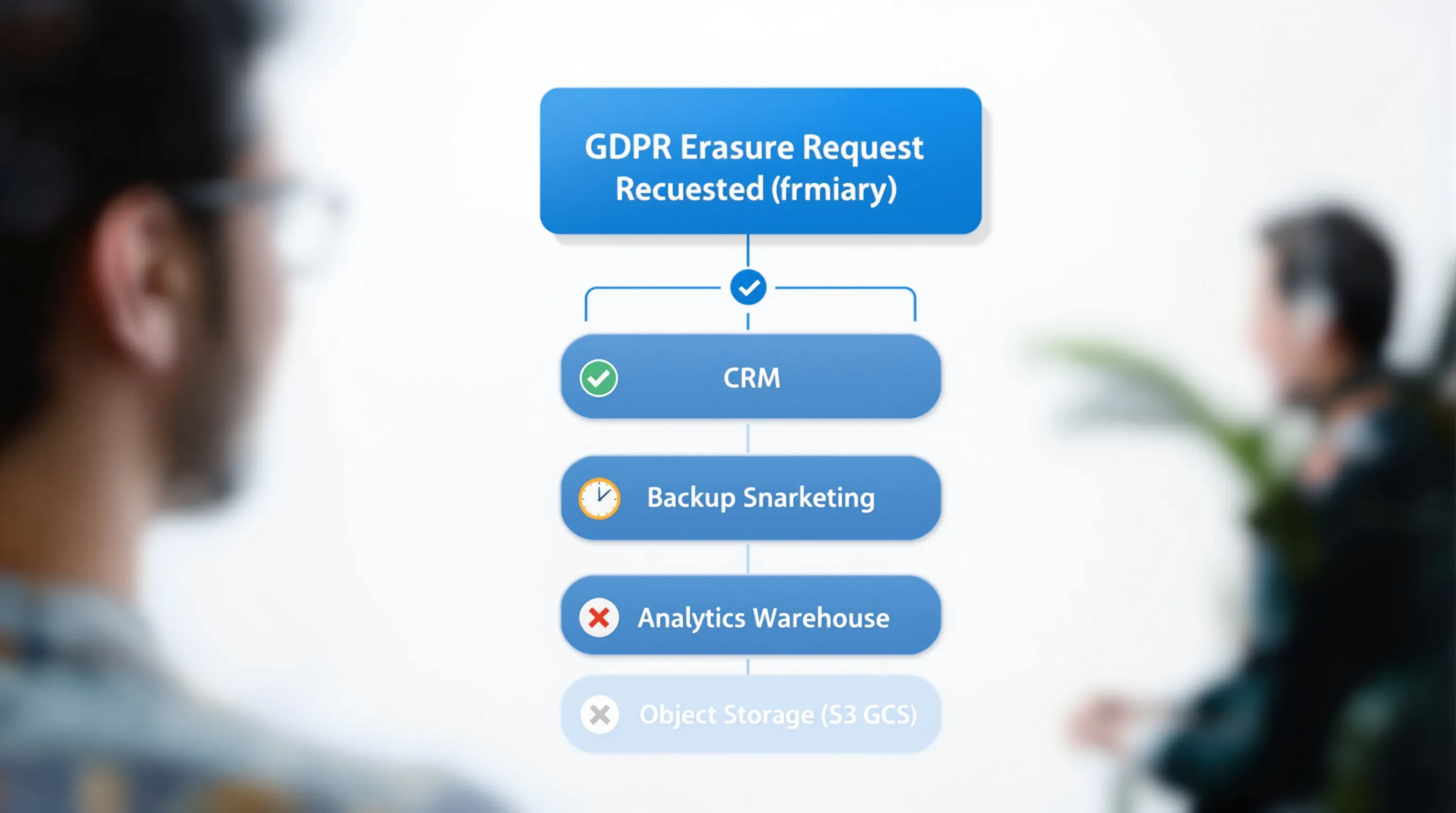
Before
What "GDPR delete" delivers vs. what full erasure requires
After
| Data location | Vendor "delete contact" covers it? | Full erasure requires |
|---|---|---|
| Primary contact record | Usually (anonymized or removed) | Hard delete confirmed in documentation |
| Conversation transcript | Often not | Verify scope in vendor documentation |
| File attachments (object storage) | Rarely | Confirm vendor runs a dereferenced-file purge |
| Backup snapshots | No | Document window; confirm or request exclusion |
| CRM copy | No | Separate deletion request to CRM platform |
| Analytics / data warehouse | No | Row-level deletion request to analytics tool |
| Email marketing platform | No | Suppression + deletion request to ESP |
| Outbound email archive | No | Archive search and targeted deletion |
| Call / screen recordings | No | Direct deletion request to recording provider |
What will matter most for help desk erasure compliance in the next 12 to 24 months?
Three developments are converging that will raise the practical stakes of help desk erasure compliance over the next two years. Each extends the existing challenge rather than replacing it.
AI model training and unlearning requirements are moving from technical concern to regulatory agenda. Several EU member state data protection authorities have begun issuing guidance on whether personal data used to train generative AI models can be considered "erased" within the meaning of Article 17, or whether it must be removed from the model weights through a process called machine unlearning. Help desk vendors whose data processing agreements permit or have historically permitted model training on customer conversations now face a question they cannot answer with current technology: can they erase a specific person's data from a model that has already been trained on it? The answer, at present, is that machine unlearning at the individual record level is not reliably available at scale. DPOs should flag this explicitly in any DPA negotiation with AI-enabled help desk vendors.
Regulators are increasing their focus on data retention as an enforcement priority. Recent DPA enforcement actions in Germany, Ireland, and the Netherlands have included findings specifically about retention periods that exceeded what was necessary for the stated processing purpose. Help desks that have not implemented active data retention policies, where old tickets and closed contacts are deleted on a defined schedule rather than kept indefinitely, are accumulating erasure exposure with every passing month. Building a retention policy is no longer purely a best-practice recommendation; it is becoming an enforcement prerequisite.
Interoperability and data portability requirements under the EU Data Act and Digital Markets Act are creating new integration complexity. As platforms are required to support data portability across more data types and in more directions, the number of downstream copies of a customer's data will grow further. The integration propagation problem described in this article will be harder to manage, not easier, as more platforms gain the ability to receive data flows from help desks and support tools. Organizations that map their data flows now and build systematic deletion processes are building a capability they will need regardless of how the specific regulatory landscape shifts.
Forward Signal - 12-24 months horizon
Where Help Desk Data Erasure Is Headed
Three scored forecasts on how customer support tools will handle GDPR deletion across backups, tickets, and connected systems.
Three forecasts for support data deletion
Use each forecast to judge whether a support tool can actually erase your data everywhere it lands, not just in the front-end.
Buyers will increasingly require support tools to delete ticket history separately from account deletion, moving GDPR from a single procurement checkbox to a tested capability, after cases where EU residents asking only to remove ticket history were told deletion was 'not possible' or handed a generic account-closure reply.
Support platforms will shift from manual, contact-support deletion toward built-in erasure and export APIs that classify data into immediate deletion, anonymization, legal hold, and dependent deletion, and that reach into backups and downstream integrations rather than only the primary ticket store.
Even as tooling improves, 'fully honoring' erasure will remain unattainable in most support stacks; the market will normalize anonymization plus documented legal-hold exceptions for records like financial, tax, and fraud logs, and cross-border compulsion such as the US CLOUD Act will keep some data reachable regardless of a deletion request.
Signals worth watching, not trusting yet Data controllers are already trying to automate erasure requests because they are 'becoming more common' and manual handling is 'no longer reasonable,' while builders publish patterns for deletion and export APIs. Procurement lists still treat GDPR as a one-line 'must be GDPR compliant' checkbox, even as individual requesters report vendors conflating ticket-history erasure with full account deletion. Practitioner guidance already splits user data into buckets where certain records legally cannot be deleted, and vendors default to retaining data even after account or trial expiry.
Sources behind and against each call
Each forecast lists the supporting sources alongside the ones that cut the other way.
- Can I request the deletion of my support ticket history under GDPR? points the same way. [Community / Forum]
- The case rests on Freshdesk alternative with responsive design or full feature app. [Community / Forum]The original poster (u/fatgituk) self-identifies as "a lone Councillor," not a sysadmin, handling casework via phone, email, Facebook, and self-generated tickets. “I['ve] had some issues with tickets not deleting or updating via the app.”
- How to make GDPR information request or right to erasure request? points the same way. [Community / Forum]The right to erasure is not absolute - an organization may delete all, some, or none of a person's data depending on the relationship (commenter gusmaru). “In practice some companies just kinda suck about this.”
- If someone submits a GDPR erasure request am I allowed to keep a supports this forecast. [Community / Forum]The original poster (Critical_Air_9549) is a data controller seeking to automate GDPR erasure requests because they are "becoming more common" and manual handling is "no longer reasonable.". “the right to deletion is not absolute and why you must keep some data, they generally calm down (or they complain to a DPA, who will tell them I was right,…”
- GDPR Implementation: Building Data Deletion and Export APIs That Actually Work is what puts this forecast on the board. [Blog]GDPR non-compliance can incur fines of up to €20 million or 4% of annual global turnover, whichever is higher (source: article, citing GDPR). “Remember when GDPR first dropped in 2018 and every company was scrambling like it was Y2K all over again?”
- Stew Leonard's Privacy Policy: Fresh Groceries, Stale Data Playbook supports this forecast. [Substack / Newsletter]Article published Oct 27, 2025 by Jay Mandel, affiliated with the Clean Data Alliance (CDA). “Manual consent revocation is an early gesture toward revocable consent, a right CDA treats as essential.”
- GDPR Implementation: Building Data Deletion and Export APIs That Actually Work points the same way. [Blog]GDPR took effect in 2018; the author notes most companies responded by only adding a cookie banner (source: article).
- GDPR-Compliant Hosting: Best Practices for Developers in 2025 supports this forecast. [Blog]GDPR was implemented/enforced in 2018 and governs how personal data is gathered, handled, kept, and moved. “When possible, make sure deletion requests also delete data from backups or archived settings." *(author, on right to erasure)*”
- Live Chat for Websites | Customer Support Software is what puts this forecast on the board. [Industry Publication]Provide Support states chat transcripts and offline messages are sent via an encrypted channel and are not stored on their servers; encryption occurs during transmission from their server to the customer's mail server. “We do not store them on our servers." - Provide Support FAQ, on chat transcripts/offline messages.”
What could shift these forecasts
Regulatory pressure, legal-hold obligations, and cross-border data rules are the conditions that would move these calls.
A qualified forecast
Our strongest confidence sits with 71, while 69 is the one most likely to divide opinion.
- If aggressive regulator enforcement of the €20 million or 4% of global revenue penalty specifically against incomplete propagation would accelerate automated erasure.
- If conversely, expanded legal-retention mandates or cross-border compulsion like the US CLOUD Act would entrench retention and stall full deletion.
Key Takeaways
Key takeaways
- A help desk "delete" button addresses one data layer. Backups, integrations, object storage, outbound email archives, and recordings each require separate, documented deletion actions.
- Backup snapshots retain deleted data for weeks to months depending on vendor tier. ICO guidance requires a documented purge plan, not passive waiting for the snapshot to expire.
- No integration cascade is automatic. CRM, email marketing, analytics, and CDP records survive help desk deletion until you explicitly request erasure from each connected platform.
- The accountability principle requires a written log. Retain your erasure request record, the confirmation from each system, and the response to the data subject for five years.
- Vendor GDPR certification does not transfer controller liability. The end-to-end erasure obligation belongs to you as the data controller, regardless of what your vendor's compliance badge claims.
Honoring a GDPR erasure request completely requires treating deletion as a workflow, not a button click. The vendor's delete feature is the starting point. Backup documentation, integration-by-integration deletion, object storage confirmation, and the final written response to the data subject are the rest of the process. The accountability principle requires that you can demonstrate every step was taken, which means the log you maintain is as important as the actions you take.
The choice of help desk platform affects how much of this work is manual. Platforms that offer genuine hard deletes on primary records, clear documentation of what survives deletion, and data processing agreements that address backup retention and integration-level erasure reduce the compliance gap significantly. Those are the questions worth asking before you sign a contract, not after you receive your first deletion request under a regulatory deadline. For an independent assessment of how current platforms compare on these criteria, start with our guide to the best help desk software with live chat.
If you are evaluating help desk options with data privacy requirements in mind, start with our tested comparison of help desk software with live chat - it covers the platforms most commonly used by support teams handling GDPR-regulated customer data.
Frequently asked questions
Does a GDPR erasure request apply to closed support tickets?
Yes, in most cases. Closed tickets contain personal data, and if the legal basis for retaining them was consent or contract necessity and those bases no longer apply, the erasure obligation covers the ticket data. The exception is when retention is required by law, such as financial record-keeping obligations, or when the data is needed to establish or defend a legal claim. For ordinary closed support tickets with no ongoing dispute, the erasure obligation typically applies.
Can I refuse a GDPR deletion request from a support customer?
You can refuse or limit deletion when a specific Article 17 exception applies: legal claims, legal obligations, public interest, or freedom of expression. You cannot refuse simply because deletion is technically inconvenient. If you apply an exception, you must document it and communicate it to the data subject in writing within the response window.
How long do I have to respond to a GDPR erasure request?
One calendar month from receipt of the request, under Article 12. This window can be extended to three months for complex or high-volume requests, but you must notify the data subject of the extension within the first month and explain why it is needed. Silence beyond one month without notification is a compliance failure.
Does deleting a contact from my help desk also delete it from my CRM?
No. Help desk deletion does not cascade to connected CRM systems. CRM platforms such as Salesforce and HubSpot retain their own records independently. You must submit a separate deletion request through each platform's own interface or API.
Is anonymizing a customer record the same as deleting it for GDPR purposes?
It can be, but only if the anonymization is genuinely irreversible and the data cannot be re-identified. Replacing a name with "Deleted User" while retaining the original email address, ticket thread, or any other identifier does not constitute anonymization. Pseudonymization (such as hashing an email) is still personal data under the GDPR definition.
What happens to support ticket data in backups after I delete a contact?
The data remains in backup snapshots until those snapshots expire under the vendor's retention schedule. Standard SaaS backup retention runs from 30 to 180 days depending on tier. The ICO requires a documented plan for purging the data from backups; it does not exempt backups from the erasure obligation. Confirm your vendor's backup retention period and document it in your erasure response to the data subject.
Summarize This Article With AI
Open this article in your preferred AI engine for an instant summary.
Read next

Data export lock-in: the support contract clause to check
Built-in help desk exports can drop threads, notes and attachments, so learn which data-return terms on format, completeness and fees decide switching…
Read
Light agent seats: which help desk actions trigger a full license
Replying to customers, not reading or adding internal notes, is what usually pushes an occasional helper onto a paid help desk seat. See the permission…
Read
The Metric Continuity Map for switching help desk software
Will your support metrics change if you switch help desk software? Learn why FRT and CSAT drift by definition and how to map 6 metrics before cutover.
Read