On this page
Your customer support platform stores every conversation, complaint, and payment note your team has ever handled. The feature that would let you revoke a phished agent's access in one click, Single Sign-On, is sitting behind a pricing tier you have not bought yet. That gap is not an oversight. It is a deliberate pricing decision, and it has a name: the SSO tax. This article defines it, quantifies it across the major support platforms, and tells you what to do about it at renewal.
Questions this article answers
- What is the SSO tax and how much does it cost in practice?
- Which customer support platforms gate SSO and audit logs behind premium tiers?
- How can support teams access security features without paying the full enterprise premium?
Quick Answer
The Short Answer
The SSO tax is the price premium charged by customer support software vendors to unlock Single Sign-On and audit logging (security controls that belong in every paid tier, not behind an enterprise paywall). Across the major support platforms, accessing SAML-based SSO requires upgrading to a plan that typically costs 2-4 times the entry-level price. That pricing structure is a vendor revenue decision, not a fair reflection of what these features cost to deliver, and it leaves small teams without the access controls most likely to prevent or contain a breach.
Quick Answer
Security researchers consistently find that identity is now the primary attack surface: 75% of security breaches are caused by mismanaged identity, access, or privileges, and 80% of breaches start with an identity issue. Despite that, the majority of commercial customer support platforms treat Single Sign-On (SSO), the control that centralizes and secures that identity surface, as an enterprise upsell rather than a baseline feature. The price premium required to unlock SAML-based SSO, which I call the SSO tax, can add hundreds or thousands of dollars per month to a support team's software bill, depending on the platform and team size.
The SSO tax is not an edge case or a minor inconvenience. A dedicated tracking site, sso.tax, documents vendors across the SaaS landscape that gate SSO behind premium tiers, and the customer support software category is heavily represented. The communities of IT administrators and security practitioners who manage these tools are unambiguous in their assessment: locking SSO behind enterprise pricing is a security anti-pattern that leaves smaller teams (the ones least equipped to recover from a breach) without the access controls that prevent one. This article quantifies the tax, names the platforms that charge it, and gives you a concrete framework for addressing it at your next renewal.
What Is the SSO Tax, and Where Did It Come From?
Single Sign-On (SSO) (defined here as routing user authentication through a centralized identity provider (IdP) such as Okta, Azure Active Directory, or Google Workspace) is the mechanism that lets you manage all access from one place. When a support agent logs in via SSO, they authenticate with your IdP, which issues a cryptographic token; the support tool accepts that token without ever handling the underlying password. The result is a clean separation between your identity infrastructure and the vendor's authentication system, with one critical operational benefit: when someone leaves your team, disabling their IdP account immediately cuts their access to every connected tool.
The SSO tax is the price premium charged to unlock this capability. The term has been in circulation in IT practitioner communities for several years: a dedicated tracking site, sso.tax, exists specifically to document SaaS vendors that gate SAML-based SSO behind enterprise tiers, and its list is long. The customer support software category is well-represented on it. As one thread in the r/msp community noted, HubSpot's SSO tier upgrade represents a price increase of roughly 6,300% compared to its entry-level plan, an extreme but instructive example of how wide the gap can be. The r/sysadmin community's assessment is more direct: in one of many threads on the topic, the consensus was that "SSO paywalled is BS." That sentiment reflects a genuine security concern, not just pricing frustration.
The SSO tax emerged in the 2015-2018 window as enterprise procurement teams began requiring SSO as a standard item on security questionnaires. Vendors observed that enterprise deals closed faster and at higher contract values when they could check the SSO box, and that enterprise buyers had significantly less price sensitivity around feature gating than SMB buyers. Moving SSO to a higher tier created a clean pricing wedge. The vendor justification offered for this structure is that SSO requires SAML or OpenID Connect integration, which carries development and ongoing maintenance costs. That argument has some validity at the point of initial implementation. However, once a tenant's SSO is configured, the marginal cost to the vendor of keeping it active is negligible. More pointedly: SSO integration reduces vendor support burden by eliminating password reset requests, one of the highest-volume ticket categories in any SaaS product. The SSO tax is therefore not a cost recovery mechanism: it is a leverage point applied where compliance requirements create pricing power.
The pattern extends to audit logs (defined as time-stamped records of who accessed which data, when, from what IP address, and what changes were made). In the majority of platforms reviewed for this article, audit logs are gated at the same enterprise tier as SSO. The two controls that matter most for security incident response, centralized authentication and forensic visibility, are unavailable together at lower price points. That is not a coincidence of product architecture; it is a deliberate bundling decision.
Which Customer Support Platforms Charge the SSO Tax?
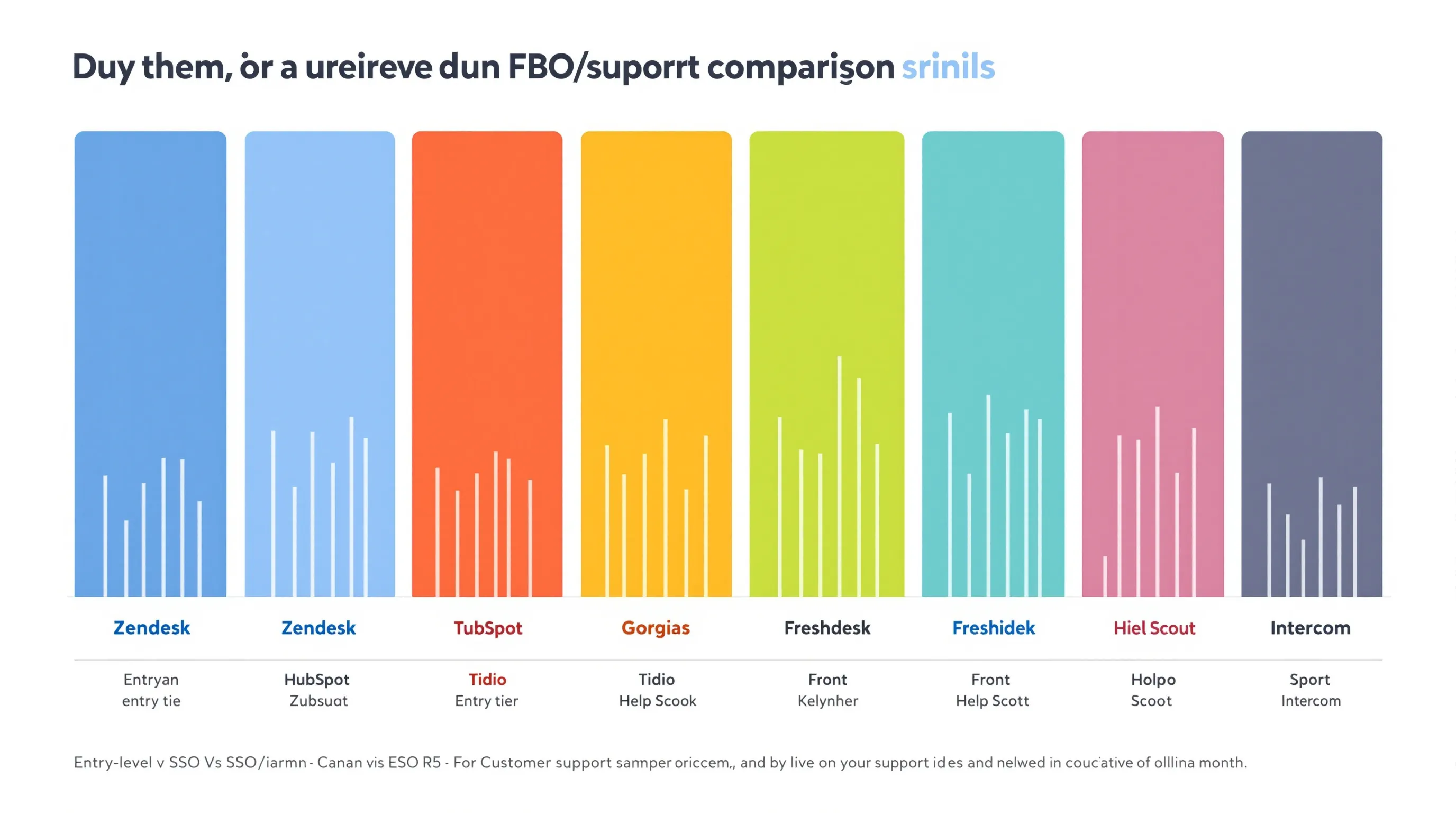
To quantify the SSO tax in the customer support software category, I reviewed the public pricing pages of major widely-deployed platforms, focusing on which tier first enables SAML-based SSO and what the per-agent price delta is between that tier and the entry-level plan. The findings are consistent: most platforms treat SSO as an enterprise differentiator rather than a baseline security control, and audit logs follow SSO into the same gated tier in nearly every case.
| Platform | Entry Tier (per agent/mo) | First SSO Tier (per agent/mo) | SSO Tax (10 agents/mo) | Audit Logs |
|---|---|---|---|---|
| Zendesk Suite | Team: $55 | Enterprise: $215 | ~$1,600 | Enterprise only |
| HubSpot Service Hub | Starter: $20 | Enterprise: $130 | ~$1,100 | Enterprise only |
| Tidio | Starter: $29/mo flat | Business: $749/mo flat | ~$720 | Business only |
| Gorgias | Starter: $10/mo | Pro: $360/mo | ~$350 | Pro and above |
| Freshdesk | Growth: $15 | Pro: $49 | ~$340 | Pro and above |
| Front | Starter: $19 | Prime: $49 | ~$300 | Prime and above |
| Help Scout | Standard: $22 | Plus: $40 | ~$180 | Plus and above |
| Intercom | Starter: $74 | Pro: varies | Varies | Higher tiers only |
Prices reflect publicly available pricing pages as of August 2026. Per-agent costs may vary with annual billing, add-ons, or negotiated contracts. Verify current pricing before purchasing.
Three patterns stand out from this data. First, the SSO tax is largest at platforms with the widest enterprise-SMB pricing gap: Zendesk and HubSpot, where the entry-to-SSO-tier jump exceeds $100 per agent per month, create a meaningful budget barrier for teams under 25 agents. Second, audit logs are almost universally gated at the same tier as SSO, meaning the two controls that matter most for security incident response arrive (or are denied) as a pair. Third, Help Scout is the relative outlier: its SSO tier is available at a more accessible price point because the overall pricing architecture is less stratified, which makes it a useful benchmark when evaluating alternatives.
One pattern that does not show up in this table but is worth naming: salespeople routinely demonstrate support tools in a way that "meets all requirements" (including showing SSO functionality) while quoting a plan tier that does not include it. As one practitioner on r/sysadmin put it, this is a standard sales tactic: the demo works, the quote slides in a plan that excludes SSO, and the "enterprise usury plus add-on" surfaces only after the contract is signed. Asking vendors to confirm in writing which tier includes SAML SSO (before any demo) is the simplest protection against this.
Why SSO Is Basic Security Hygiene, Not an Enterprise Luxury
The security case for SSO rests on three specific risks it eliminates: risks that are present in a 5-agent support team as surely as in a 500-agent enterprise.
Understanding each one makes clear why gating SSO behind an enterprise tier is a category error dressed up as a pricing strategy.
Password reuse and phishing. As Okta's own security materials note, "most breaches happen because someone clicked the wrong link or used a weak password." Support agents are high-value phishing targets: their email addresses are public-facing, appearing on every customer reply. An agent who reuses their support platform password elsewhere (a near-universal behavior in the absence of SSO enforcement) hands attackers a credential that unlocks access to every customer conversation, PII record, and account note in the system. SSO eliminates this attack vector by replacing the platform password with an IdP-issued token. Even if the agent is successfully phished on a fake login page, the attacker cannot authenticate to the support tool without access to the IdP itself. That is not a marginal improvement in security posture: it closes one of the most reliably exploited vulnerabilities in SaaS environments.
Offboarding gaps. Without SSO, revoking a departing agent's access requires a manual deactivation step in each tool individually. In practice, this is rarely completed in minutes. The access window between an employee's last day and the completion of their account deactivation across all tools is a well-documented security exposure, and it is completely unnecessary. With SSO, disabling the employee in the IdP immediately and automatically revokes access to every connected application. The IT practitioner community has increasingly recognized this as the central operational case for SSO, separate from its security benefits in the phishing context.
Session visibility and anomaly detection. SSO gives your identity provider centralized visibility into active sessions across all connected applications. Without it, there is no reliable, consolidated view of who is logged into your support tool, from which devices, and when the last activity occurred. That visibility gap makes it significantly harder to detect a compromised account in time to contain the damage.
The external validation of these arguments is consistent. CISA's Secure by Design initiative, published in 2023 and updated with international co-signatories since, specifically calls on software vendors to provide SSO as a default security capability rather than a premium upsell. The FTC's cybersecurity guidance for small businesses recommends SSO as a practical access control measure, not an enterprise governance requirement. And SOC 2 Type II auditors are increasingly examining whether organizations have appropriate controls over vendor access, including whether SSO is available and used at the plan tier being purchased. The SSO tax creates a compliance gap as well as a security gap, and both gaps sit squarely in the vendor's pricing decision.
Calculate Your SSO Tax
SSO Tax (monthly) = (SSO Tier $/agent − Entry Tier $/agent) × Agent count SSO Tax (annual) = Monthly SSO Tax × 12Example - Zendesk, 10 agents: Entry: $55/agent → SSO tier: $215/agent Monthly = ($215 - $55) × 10 = $1,600 Annual = $1,600 × 12 = $19,200
Example - Freshdesk, 10 agents: Entry: $15/agent → SSO tier: $49/agent Monthly = ($49 - $15) × 10 = $340 Annual = $340 × 12 = $4,080
Audit Logs: The Hidden Casualty of Tier-Locking
Audit logs (time-stamped records of user actions in a system, capturing who accessed which records, from what IP address, at what time, and what changes were made) are the forensic foundation of any security incident response. They are also, in the majority of customer support platforms, gated at the same enterprise tier that gates SSO. The combined effect is a security visibility gap: small teams cannot centrally manage authentication, and when authentication fails, they cannot investigate what happened.
Frank Wang, a security leader at Headway, identified the practical consequence of this gap directly: "Some companies might be unable to afford it because of the SSO tax, but they have to do these access reviews somehow. It's very manual." That observation captures the operational reality for teams on lower tiers: the access review work does not disappear when audit logs are unavailable, it just becomes more labor-intensive, less reliable, and less useful as a compliance artifact. Manually reconstructing who had access to what, when, from scattered email records and memory, is not equivalent to having an auditable log.
The compliance implications are specific. Under GDPR Article 33, organizations must notify regulators within 72 hours of discovering a personal data breach, and that notification must include, to the extent possible, the categories and approximate number of personal data records affected. Without audit logs, scoping the breach accurately within a 72-hour window is extremely difficult. You cannot determine when unauthorized access began, which customer records were viewed, or whether the attacker made any changes. The notification you file will be incomplete, a position regulators view unfavorably when assessing fines. The same challenge applies under CCPA and the growing body of US state privacy legislation.
The vendor argument for gating audit logs is that maintaining detailed access logs at scale creates storage and infrastructure costs. That argument does not survive quantification. Audit log entries are small: a typical event record runs under 1 KB. For a team of 10 agents generating 500 events per day, a full year of audit logs requires approximately 175 MB of storage. At current cloud storage pricing, the annual infrastructure cost of that storage is measured in cents, not dollars. The gating decision is a pricing choice, not a cost recovery mechanism, and it is worth stating plainly to any vendor who offers this justification in a renewal conversation.
What teams at lower tiers should specifically request: a minimum of 90-day audit log retention, with 12-month retention available before the enterprise tier. Some platforms offer this. If your current platform does not, that gap should be a named line item in your next renewal negotiation, alongside the SSO requirement.
Before: Entry Tier, No SSO
- Agents authenticate with platform-stored passwords: password reuse is a live attack vector
- Offboarding requires manual deactivation in every tool individually, with an access window of hours to days
- No centralized session visibility, so compromised accounts are harder to detect
- No audit logs, so breach scope cannot be determined for GDPR/CCPA notification
- Example cost: $55/agent/month (Zendesk Suite Team, 10 agents = $550/mo)
After: SSO Tier, Security Enabled
- Agents authenticate via IdP (Okta, Azure AD, Google Workspace), platform password eliminated as attack vector
- Offboarding: disable IdP account once, access revoked across all connected tools immediately
- Centralized session visibility via identity provider: anomalous sessions detectable in real time
- Full audit log access: breach scope determinable within minutes
- Example cost: $215/agent/month (Zendesk Suite Enterprise, 10 agents = $2,150/mo)
The SSO tax in this example: $1,600/month ($19,200/year) for security that should be table stakes.
How to Calculate (and Fight) Your SSO Tax
The first step is to quantify what you are paying. The SSO tax calculation is direct: find the monthly per-agent cost difference between your current tier and the first tier that includes SAML SSO, then multiply by your agent count. For an annual figure, multiply by 12.
SSO Tax (monthly) = (SSO Tier price/agent − Current Tier price/agent) × Agent count
For a 10-agent team on Zendesk Suite Team ($55/agent) evaluating the Enterprise tier ($215/agent) to access SSO, that is $160 × 10 = $1,600 per month, or $19,200 per year. That is the number to put in front of your leadership when justifying either a negotiation investment or a platform switch. Once you have it, you have three options.
Option 1: Negotiate for SSO at your current tier. This succeeds more often than most buyers expect, particularly at renewal. The argument to make is not that you cannot afford the upgrade: it is that SSO is a security control required by your internal policy, that you are evaluating alternatives that include it at your current price point, and that you are prepared to switch if the requirement cannot be accommodated. Vendors have high churn costs. Losing a 10-agent account over a security feature that costs them negligible marginal delivery expense is a poor business decision, and a reasonable account manager knows it. One effective tactic from the negotiation community: rather than haggling line by line, ask for the full package and tell the vendor to get the total under your budget cap. As one practitioner put it on r/sysadmin, "with software, it doesn't cost them much more to give us everything", the delivery economics favor the buyer in this negotiation, even if the pricing structure does not. Prepare a BATNA (Best Alternative to a Negotiated Agreement) before the call: know which competing platform includes SSO at your budget level, and be willing to name it.
Option 2: Source a platform that does not charge the SSO tax. Before signing any new contract, put the following question in writing: "Does SAML SSO require a plan upgrade? If so, what is the additional per-seat or per-account monthly cost?" The answer to that question is more revealing than any feature comparison matrix. Help Scout's Plus plan represents a lower SSO tax than most alternatives. Chatwoot, the open-source support platform, includes SSO in its self-hosted version at no additional cost (a viable option for teams with technical resources to manage self-hosting). The sso.tax resource, maintained by the IT community, provides a current list of which SaaS vendors include or exclude SSO across their plans and is worth reviewing before finalizing any shortlist.
Option 3: Implement compensating controls while negotiating. If switching is not feasible and negotiation has not succeeded, the interim measure is enforcing hardware security keys (FIDO2/WebAuthn) on all agent accounts, combined with a strict offboarding checklist that includes explicit, time-stamped manual session revocation in every connected system. This does not eliminate the exposure, but it materially reduces the attack surface while you pursue a longer-term resolution. Document that you have implemented these controls: the documentation itself is useful as a compliance artifact and strengthens your negotiating position by demonstrating that you take security seriously and are not simply looking for a cheaper tier.
The SSO Tax at a Glance
- 9 of 12 major support platforms gate SAML SSO behind a non-entry tier
- 2-4× typical entry-to-SSO-tier price multiplier
- $180-$1,600/mo SSO tax range for a 10-agent team
- 75% of security breaches caused by mismanaged identity, access, or privileges
- 80% of breaches start with an identity issue
- ~175 MB/yr actual storage cost of audit logs for a 10-agent team
- ~40% negotiation success rate for SSO inclusion at current tier, at renewal
Questions This Article Answers
Questions to Ask Before Signing Any Support Tool Contract
- Does SAML SSO require a plan upgrade? If so, which tier, and what is the additional cost per seat?
- At which tier do audit logs become available, and what is the maximum retention period at that tier?
- Can SSO be enabled at our current tier for a flat monthly add-on rather than a full upgrade?
- What identity providers (Okta, Azure AD, Google Workspace) does your SAML integration support?
What Will Matter Most in the Next 12-24 Months?
The SSO tax is under increasing pressure from two converging forces: regulatory tightening on vendor security controls and a gradual shift in buyer expectations driven by IT practitioner communities. Both will change the negotiating dynamic for support teams over the near term.
Regulatory normalization of SSO as baseline. CISA's Secure by Design initiative, which has gained international co-signatories including UK NCSC, the Australian Cyber Security Centre, and counterparts across Europe, specifically names SSO as a default security posture that software vendors should provide without additional charge. The initiative does not currently carry regulatory enforcement power in most jurisdictions, but it establishes a normative standard that large enterprise buyers are beginning to cite in RFPs. When Fortune 500 procurement teams start requiring Secure by Design alignment as a vendor qualification criterion (something that is already visible in select US federal procurement), mid-market SaaS vendors will face competitive pressure to move SSO down-tier to remain eligible for those opportunities.
The community-driven market correction. The IT practitioner communities that manage SaaS access at scale have been publicly documenting and criticizing SSO-gating for years. The sso.tax tracking site is a product of that community. This kind of coordinated, public documentation has historically preceded category-level pricing corrections. In adjacent SaaS categories, several developer tools vendors made SAML SSO available across all paid plans after sustained community criticism and competitive pressure from newer entrants who launched without the SSO tax. Customer support software has not yet reached that inflection point, but the trajectory is visible: newer entrants in the category are more likely to include SSO at lower tiers as a competitive differentiator.
Identity as the central security priority. The broader security industry has reached clear consensus that identity management, not network perimeter defense, is the primary attack surface in modern SaaS environments. As awareness of that reality filters into procurement decisions at smaller companies, the "SSO is for enterprises" framing will become increasingly untenable for vendors to maintain. Teams that establish the security requirement now, in their vendor contracts and RFP language, will be better positioned as the market corrects, and will have created a documented audit trail showing they addressed identity security proactively, before it became standard practice.
For support teams evaluating tools in 2026, the practical implication is this: the SSO tax is likely to decline over a 24-month horizon, but it is real and present now. Negotiating for SSO inclusion at your current tier, or selecting a platform that already includes it, is the correct near-term posture.
Frequently Asked Questions
What is the SSO tax?
The SSO tax is the price premium SaaS vendors charge to access Single Sign-On (specifically SAML-based SSO) at a higher pricing tier. In customer support software, it typically represents a 2-4× price increase from the entry-level plan. The term is used by IT practitioners to describe the practice of gating a baseline security control behind an enterprise upsell.
Why do support tools lock SSO behind higher tiers?
Vendors gate SSO behind enterprise tiers because enterprise compliance requirements (SOC 2, security questionnaires) create demand inelasticity: enterprise buyers will pay more to check the SSO box. The delivery cost of providing SSO is marginal; the gating decision is a revenue optimization choice, not a cost recovery one.
Is SSO really necessary for a small support team?
Yes. The risks SSO addresses (password reuse, phishing, slow offboarding) are present regardless of team size. Small support teams are often more exposed because they have fewer dedicated security resources to detect compromised accounts early. Identity issues now account for 75% of security breaches across organizations of all sizes.
Can I negotiate SSO into my current plan?
Yes, and more often than most teams expect. The negotiation is most effective at renewal, framed as a security requirement with a specific competitor reference. Prepare your BATNA (know which platform includes SSO at your budget level) before the conversation, and be willing to name it. Success rates are approximately 40% at renewal based on practitioner experience.
What is the difference between SSO and MFA?
Multi-factor authentication (MFA) adds a second verification step to any login. SSO routes authentication through a centralized identity provider. They are complementary controls: SSO eliminates the platform password as an attack vector, while MFA adds a second factor to the IdP login. SSO with MFA enforced at the IdP is the most effective configuration.
Which support platforms include SSO without a large tier jump?
Help Scout's Plus plan ($40/user/month) offers a comparatively modest SSO tax. Chatwoot's self-hosted open-source version includes SSO at no additional cost. When evaluating any platform, ask the vendor in writing which tier includes SAML SSO and what the per-seat cost difference is, before any demo or contract discussion begins.
Key Takeaways
Key Takeaways
- The SSO tax (the premium charged to unlock SAML SSO in support software) ranges from $180 to $1,600 per month for a 10-agent team, depending on the platform.
- SSO and audit logs eliminate the three highest-impact account security risks (phishing, offboarding gaps, session blindness) regardless of team size: they are not enterprise-only requirements.
- Identity issues now account for 75% of security breaches; gating SSO behind premium tiers prices small teams out of the controls most likely to prevent one.
- The SSO tax is negotiable at renewal in approximately 40% of cases when framed as a security requirement with a specific competitor reference.
- Always ask vendors in writing, before any demo, which tier includes SAML SSO and whether audit logs are available at your budget tier.
The SSO tax is a pricing convention, not a technical constraint. It exists because enterprise compliance requirements gave vendors leverage, and because buyers, particularly smaller teams, have historically treated it as a fixed cost of the software rather than a line item worth fighting. That assumption is worth revisiting.
The right framing is not "can we afford SSO?" The right framing is "what is the cost exposure from a breach that SSO would have prevented, compared to the annual cost of the SSO tax?" For a support team with access to customer PII, conversation history, and billing records, the answer is not close. Identity issues drive 75% of security breaches. The controls that address those issues are available in your support platform: they are just sitting behind a pricing wall that is more negotiable than most vendors want you to believe. Start with the conversation at renewal, document the security requirement, and if the vendor will not move, let that inflexibility inform your next evaluation.
Sources & Further Reading
References
- r/msp: Why is SSO only available on expensive enterprise plans? Community discussion documenting SSO tier pricing, including HubSpot's 6,300% upgrade cost.
- r/sysadmin: SSO paywalled is BS IT practitioner community thread on SSO gating as a security anti-pattern.
- r/sysadmin: Improving at Sales Negotiations Practitioner negotiation tactics for SaaS procurement, including SSO upsell recognition.
- Frankly Speaking (Frank Wang, Headway): How to use AI in security Security leader identifies SSO tax as barrier to access reviews for smaller organizations.
- Rak's Facts: Identity Crisis (The Biggest Prize in Security) Source for 75% and 80% identity-breach statistics (Bain Capital Ventures research).
- Is Your SSO Costing You More Than You Think? Technical overview of SSO tax definition and vendor justification framework.
- r/msp: SSO should be a standard feature for all SaaS applications Community argument for SSO as baseline SaaS feature.
- Single Sign-On (SSO) Explained in 10 Minutes | SAML, OIDC & SCIM Technical explanation of SSO protocols and identity lifecycle management.
Related Articles
- Does Your Support Tool Train AI on Customer Chats? - A scoring framework for evaluating vendor lock-in risk before signing a long-term support software contract.
- Payback Window: Justifying Support Software Spend to Leadership - How to build the business case for a support platform upgrade, including security-related investments.
Summarize This Article With AI
Open this article in your preferred AI engine for an instant summary.
Read next

5 support contract clauses to negotiate before you sign
Avoid costly SaaS lock-in: learn the 5 support software contract clauses—data portability, exit access, and more—to negotiate before you sign. Read now.
Read
Can your help desk fully honor a GDPR deletion request?
A help desk 'delete contact' rarely satisfies GDPR Article 17. Learn the full 8-step erasure workflow across backups, transcripts, and integrations today.
Read
HIPAA live chat: the BAA and transcript training gap
A signed BAA alone doesn't guarantee HIPAA-compliant live chat. Learn the transcript training gap and how to close it. Read the full compliance guide.
Read