On this page
Quick Answer
A chatbot retrieves and replies within a set flow; an AI support agent reasons toward a goal, takes actions in your other systems, checks the result and repeats.
The gap is narrower than the labels suggest. Modern chatbots can also search documents and trigger integrations. Agents cost more per request because they loop through reasoning steps. Published resolution rates differ mostly in what each vendor counts as solved.
The measure that matters to me is whether real tickets stay closed without a person reopening them.
Key Points
- A chatbot answers within a set flow, while an AI support agent chooses its own next step toward closing a ticket and acts in your other systems.
- On the Agentic AI at Work podcast in June 2026, an AI agent marketed at 76% plus resolution benchmarked at a 51% average for Tier 1 deflection.
- Under California's AB 1609, as Quarles reads it, businesses with more than $500 million in revenue would have to offer a human within 15 minutes or an appointment within one business day.
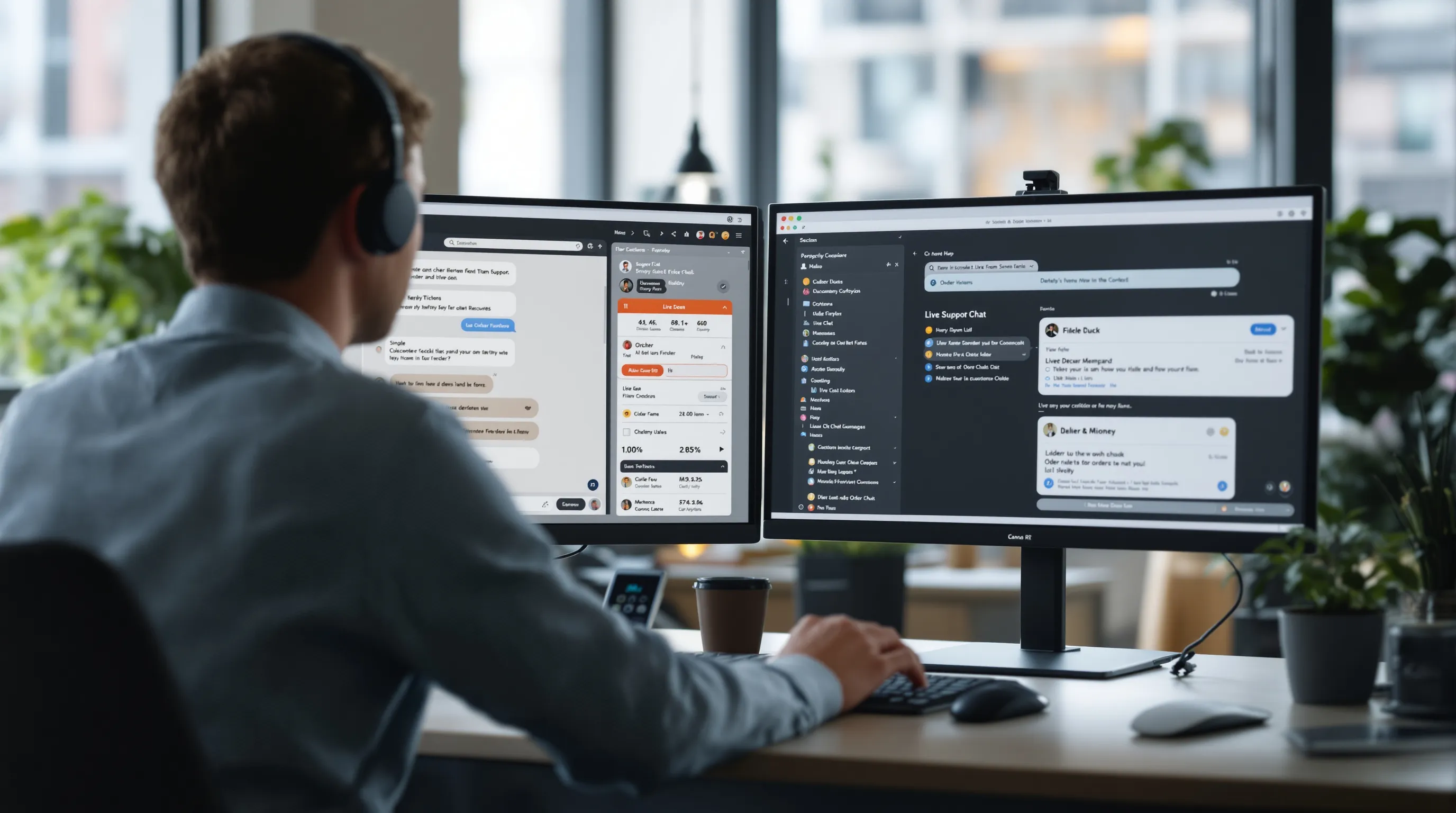
A chatbot follows the flow it was given; an AI support agent works across the ticket queue and the systems behind it.
The chatbot versus agent question now carries legal weight as well as commercial weight: by spring 2026, 98 chatbot-specific bills had been counted across 34 states, plus three federal proposals.
The Future of Privacy Forum compiled that tally. Maine's LD 1727 took effect on Sept. 24, 2025 and California's SB 243 on Jan. 1, 2026, while Nebraska's LB 525 and Georgia's SB 540 follow on July 1, 2027. Georgia's law has no carve-out for chatbots embedded in larger platforms, so Meta, Google and Apple must comply if their products fall within its definition.
The pace is striking. In 2018, an industry compilation found that only 15% of consumers had communicated with a business through a chatbot in the previous 12 months.
The technology moved as fast as the law. Engineers now describe the step from chatbot to agent as a change in execution model rather than interface: the system reasons about a goal, acts, observes the result and repeats until the goal is met. That loop is what lets an agent close a ticket on its own. It is also what makes vendor resolution claims so hard to compare.
I wrote this for the buyer weighing two proposals, one labeled chatbot and one labeled agent, with a budget for only one. The sections below separate capability from branding, set published resolution figures against outside benchmarks, and lay out the disclosure duties that arrive with either contract.
An AI agent that can move money or take irreversible actions needs permissions, logs and human approval checkpoints, argues the explainer channel Learn with Whiteboard. State laws judge what a system does, not its label.
SystemDR, a system design channel on YouTube, adds that agents introduce new attack surfaces, such as indirect prompt injection, where an agent reads a malicious web page and makes a tool call based on it. Modern chatbots can keep memory, search documents, pull data from a database and trigger integrations, so tool access no longer separates the two categories. What does separate them is agency: an AI support agent chooses its own next step toward closing a ticket, then takes it. I give the product name on a pricing page almost no weight.
Regulators arrived at a similar view. STACK Cybersecurity's compliance guide, updated in June 2026, reports that most state laws carve out standard customer service chatbots that handle narrow, transactional queries such as order status or IT helpdesk tickets. Coverage turns on capability or behavior instead. California, Washington and Connecticut ask whether a system is capable of forming an ongoing relationship with a user, however it is marketed, while Oregon and Nebraska ask whether it actually sustains one and retains context across interactions. Chatbot provisions in Washington, Oregon, Idaho and Connecticut take effect on Jan. 1, 2027. Oregon's SB 1546 adds a private right of action at $1,000 per violation.
California's AB 1609, which awaited the governor's signature in September 2026, reaches further: its definition neither includes nor excludes voice, SMS or email. So the comparison that follows starts with what each system is permitted to do, then tests the deflection numbers vendors quote.
Questions this article answers
- What is the difference between a chatbot and an AI support agent?
- Do AI support agents really deflect more tickets than chatbots?
- How do I choose between a chatbot and an AI agent for support?
Opus Research framed chatbots in 2018 as tools that free people for complex work rather than replace them. The agent question is whether that work can now be finished, not merely routed.
What is the difference between a chatbot and an AI support agent?
A chatbot primarily answers questions in conversation. An AI support agent is handed a goal and tools, then decides which steps to take, including changing records in other systems.
Before you read any vendor page, run each tool through three questions:
- Who chooses the next step? If every turn is driven by the customer's last message, the tool behaves like a chatbot. If it picks intermediate steps toward a goal, it behaves like an agent.
- Can it change state in another system? Reading an order status is retrieval. Cancelling the order, updating a subscription or processing a refund is action.
- What does it do when it cannot finish? Watch whether it stops, loops the customer back to the start, or hands off with context.
Learn with Whiteboard, a YouTube explainer channel, defines a chatbot as a conversational interface whose replies may come from a scripted decision tree, a language model, or both. "What makes it a chatbot is that conversation is the primary way you interact with it," the narrator says. An AI support agent, in the same video, is "often the same underlying model, but a different system around it": a goal, some context and a tool belt, with the system deciding what to do next.
Contrary to the common assumption, tool access is not the dividing line. The same explainer rejects the "myth that chatbots can't use tools," noting that modern chatbots can keep memory, search documents, pull from a database and trigger integrations. The real separator is agency: how much freedom the system has to choose how it reaches a goal.
Practitioners land in a similar place with blunter words. In a r/learnmachinelearning thread from November 2025, the original poster described a chatbot as one that "mostly answers FAQs or guides users through predefined flows," while an agent "can actually perform actions (like fetching order info, updating subscriptions)." One commenter compressed it further: "chatbot = talks / agent = talks and acts." Another conceded, "There's no consensus on a definition yet."
Underneath, the architecture differs. A chatbot follows a linear path: the customer prompts, the system retrieves, and it replies. Without a human stepping in, it cannot change the state of an external system. An agent instead runs a reason and act loop, and it might cycle through 10 or 20 reasoning loops on a single query. Vendor staff in practitioner forums now describe training on help docs as a solved problem; the shift they point to is resolving issues end to end using orders, past conversations and tickets.
A review of 4 sources for this section points the same way. The boundary is agency, not the model. So ask each vendor to show you one live conversation in which its tool changed a record, and who approved that change.
Our reviews at Zazachat are written and edited by an editorial team led by Daniel Calloway. If you are comparing the AI features in our best live chat software rankings, I would put each one through the three questions above before weighing price, because two tools sold under the same word can sit on opposite sides of that line. Memory is a fourth place to look: SystemDR notes that chatbots typically fill one short-term context window until it overflows, while agents add long-term memory held in vector databases.

Do AI support agents really deflect more tickets, or are the numbers misleading?
Agents usually report higher numbers, but vendors measure different things. Deflection, containment and resolution count different outcomes, so two published rates can describe the same tool very differently.
Three metrics get blurred together in vendor decks. A deflection rate is the share of inbound queries that never reach a human, which means a customer who reads an FAQ and closes the window counts as a win. Containment counts AI conversations that end without a handoff, and it cannot tell a satisfied customer from one who gave up. Automated resolution is stricter: the AI understood the question, the answer was accurate, and no human was needed.
| Metric | What it counts | What it misses |
|---|---|---|
| Deflection rate | Inbound queries that never reach a human | Whether the problem was solved, or whether the customer came back through another channel |
| Containment rate | AI conversations that end without a human handoff | The difference between a satisfied customer and one who quit |
| Automated resolution rate | Conversations that were relevant, accurate and contained | Depends on who grades accuracy, and how |
The gap is not small. A vendor-compiled roundup of support AI tools claims that conversation closed, no human handoff and customer confirmed resolved can differ by 20 percentage points. The same roundup says Intercom's Fin touts 76% plus query resolution on average, while the roundup's own benchmarks put Fin's Tier 1 deflection at a 51% average. One AI vendor's guide to these metrics works the arithmetic from the other side: a 70% resolution rate that includes 30 points of article views is really a 40% resolution rate.
Customers feel that gap directly. In a July 2025 r/artificial thread, the central complaint was bots that send people to a help page instead of fixing the issue, and one commenter put the blame squarely on the metric: "If you are only attempting to deflect calls to a bot who doesn't know your software and then cheering to your bosses about case deflection rates, you're doing it wrong." A thread in r/customerexperience from October 2025 drew the line more precisely. Simple FAQs were solved instantly with no queue, but on anything "even slightly complicated" the AI looped the poster around until they finally reached a human.
Both threads describe deflection working as designed. Neither describes resolution. A customer who gives up mid-loop still counts as deflected, and that is the number many dashboards celebrate.
My position here is firm. I won't compare two automation figures until both vendors have written down what they count as resolved, and that is the first question I would put to anyone on a shortlist of AI customer support software. The harder question is what an agent does that a chatbot cannot, and whether that capability shows up in the tickets that stay closed.
How much of the gap between chatbots and AI agents is real?
One AI support agent is marketed as resolving "76% plus" of customer questions. On a June 2026 podcast, a benchmark put the same agent at 51%. Which number should a buyer trust?
The figures come from Agentic AI at Work, a workflow automation podcast whose host reviewed deflection benchmarks for many support tools. The agent "touts 76% plus query resolution on average," the host said, yet benchmarks showed a "51% average" for Tier 1 deflection. AI built into two major helpdesk and CRM suites managed "roughly 20 to 30%" alone.
So the familiar split, roughly 20% for basic automation and 50% or more for an agent, does appear outside the marketing. Yet the chart's first comparison sets a resolution claim beside a deflection benchmark. The host noted that "conversation closed versus no human handoff versus customer confirmed resolved can differ by 20 percentage points," and that "even simple bots may hit 40 to 60% deflection." Count loosely enough and a basic bot posts an agent's number.
A March 2026 guide from the maker of one AI agent shows what loose counting adds: a "70% resolution rate" that includes 30 points of article views is really 40%. Its remedy is the 24-hour reopen rate, which it calls "the metric most vendors would prefer you not ask about." A second vendor compares how often AI-handled customers return within two or three days against customers your team helped.
Strip out loose counting and a difference remains. An AI support platform that bills only for tickets it fully resolves published a four-tier framework in October 2026, sorting tools by what they can do in other systems.
| Tier | Resolution range in the framework | What it can do in other systems |
|---|---|---|
| Legacy chatbots | 10 to 25% | Identifies the request category and routes it to a person |
| Standard AI assistants | 40 to 60% | Retrieves and explains information but cannot act on it |
| Best-in-class AI-native platforms | 55 to 70% first contact resolution | Given as the realistic first-year target for mature deployments |
| Agentic platforms | 70 to 85% end to end | Connects to CRM, billing, policy and claims systems; processes refunds and completes claims intake |
The company's co-founder argues that bottom-tier "resolution" mostly means the customer "abandoned the interaction rather than received a satisfactory outcome," while standard assistants "can explain a policy, but they cannot process changes, adjustments, or claims." The company profits when buyers value full resolution, so treat its exact ranges cautiously. Still, its core point, that tiers differ in what they can change, matches what practitioners describe.
George Vlasyev, a YouTube creator, built a billing and refund agent inside a helpdesk for a series sponsored by its maker. He points to the handoff: an escalating chatbot "provides a transcript and little else," while an agent passes on "a summary, relevant context, and a recommended next step." Capability has a ceiling too. An analysis firm cited on the podcast found "every tool's performance depended heavily on KB quality." A Reddit automation commenter was blunter: "A cleanup pass before any tool evaluation usually matters more than which vendor you pick."
The tickets a tool receives can move its rate as much as the tool itself. The tiered framework illustrates this with 46% on healthcare queries against 80% on ecommerce order-status lookups, the healthcare work being more complex. The March guide contrasts 85% of password resets with 65% of all inbound queries, refunds and account changes included. Drawing on "a lot of sales calls," a customer success forum commenter said failed rollouts usually chased 70 to 90% deflection, a target "unrealistic without proper training, knowledge resources, testing" and ongoing improvement.
The gap between chatbots and agents holds up; the size of any single advertised number does not. The meaningful difference appears when a tool can change something in another system, such as issuing a refund or updating an account. A published rate reveals that difference only when you know what counted as resolved, which tickets were sampled and how many customers came back.
Before you compare two rates
- Ask each vendor, in writing, how it defines a resolved ticket and whether article views, closed chats or conversations without a handoff count toward the rate.
- Ask what share of resolved customers come back within 24 hours, and again within 72 hours, and how that compares with customers helped by your team.
- List the tickets in your queue that need something changed, such as a refund or an account update. Ask which of those systems the tool can write to, and what it gives a person when it cannot.
- Run your own 20 or 30 most common questions through every tool you are considering, so both rates come from the same ticket mix.
- Remove contradictions and outdated pages from your knowledge base before the trial, because every tool answers from it.
How we checked this
Our sources were a June 2026 podcast transcript, two guides from AI support vendors, a sponsored YouTube video and two Reddit threads where practitioners and vendor staff discuss AI support. None of the figures are ours. We have not run deflection tests for this section, so the 20% and 50% figures come from the sources' benchmarks. The podcast host did not explain how the benchmarks were run, and the transcript was machine-generated. Both vendor guides come from companies that benefit when buyers value full resolution, and one bills per resolved ticket. The healthcare, order-status and password-reset figures are illustrations, not measurements. Reddit comments are individual accounts. We review support software and some of the cited vendors compete in our market, so we describe them without naming or linking them. Still unknown: how the tiers compare when an independent tester uses one definition of resolved on one shared ticket set.
- Agentic AI at Work podcast, episode transcript on AI support platforms, June 27, 2026.
- Guide to resolution rate versus deflection rate, published by the maker of an AI support agent, March 10, 2026. Not linked because the vendor competes in our market.
- Resolution rate benchmarks by the co-founder of an AI support platform that bills per resolved ticket, October 5, 2026. Not linked because the vendor competes in our market.
- George Vlasyev, YouTube video comparing chatbots and AI agents, July 21, 2026, sponsored by a helpdesk vendor.
- r/CustomerSuccess, thread on solving customer support with AI, February 19, 2026.
- r/automation, thread on AI tools for customer support, May 21, 2025.
How should you choose between a chatbot and an AI agent for your support team?
Score each tool on five things: its written definition of resolution, scope, cost model, handoff quality and legal fit. Deflection alone should never decide it.
Here is the order I would work through them:
- Get the definition of resolved in writing. Ask whether the figure counts article views, abandoned chats or only customer-confirmed fixes. Ask, too, how the vendor will benchmark performance and report progress after launch; a June 2025 webinar pitch co-presented by the contact center AI vendor Observe.AI listed both among its takeaways.
- Start with a narrow scope. One commenter drawing on many sales calls said the deployments that worked handled a narrow set of questions well, while the failures usually treated a 70-90% deflection rate as the measure of success. Pick your most repetitive questions first, then widen.
- Match the cost model to your volume. A scripted chatbot has no AI model running behind each conversation and no per-resolution fee. At least one help desk vendor bills AI agent resolutions only when the AI handles a conversation end to end, with no extra charge when it escalates.
- Read the handoff, not the transcript. When a scripted bot escalates, the human typically gets a transcript and little else. A well-built agent passes a summary, relevant context and a recommended next step, which is the pattern the successful deployments above shared.
- Check the law before the demo. Disclosure and human-access rules now apply to customer-facing AI whatever the vendor calls it.
The choice itself turns on a few conditions. You need an agent if customers phrase the same request in unpredictable ways, if answers depend on data held in several connected systems, if customers expect something to happen as a result of the chat, or if the automation has to improve without manual rebuilding. If none of those apply, a chatbot is a reasonable place to start.
The legal step deserves more weight than most buyers give it. The law firm Quarles, analyzing California's AB 1609 in September 2026 while it awaited the governor's signature, notes that the bill defines a "customer service chatbot" as any AI system with a "natural language interface" that gives adaptive, human-like responses for customer support. That reach covers an agent as fully as a scripted bot. For businesses with more than $500 million in gross annual revenue serving Californians, the bill requires a clear way to request a human during business hours and a good faith effort to connect within 15 minutes, or an appointment within one business day. Civil penalties are capped at $5,000 per initial violation and $10,000 per subsequent violation.
STACK Cybersecurity counted more than a dozen states with enacted chatbot laws as of June 2026, and well over 100 chatbot-related bills across more than 35 states and Congress. Most of those laws carve out standard support bots that handle narrow, transactional queries such as order status. The catch is memory. An agent that remembers past conversations and sustains open-ended dialogue moves closer to the systems those laws target, and the guide places the line between the two categories "where most compliance uncertainty lives."
Scope is a legal choice as well as an operational one. Narrow agents stay simpler to defend.
For smaller teams weighing live chat tools for small business, my advice is to treat the five checks as a gate rather than a scorecard: a tool that fails the first one never reaches the demo, and the cheapest way to learn which side of the line you sit on is to run your own top questions through both.
Where is the line between chatbots and AI agents heading?
Toward capability and proven outcomes. Buyers will increasingly separate tools by which systems they can change and how strictly each vendor defines a resolved ticket.
The cost logic explains why. A chatbot that cannot change an external system without a person is a cheap, predictable integration. An agent that can change one costs more to run, and it earns that back only when its actions close tickets a human would otherwise handle.
Builders already sell on that basis. In a March 2026 r/AI_Agents thread, one described a missed-call text triage agent for plumbers, HVAC firms and roofers that routes real emergencies to the owner for about $8 a month. Another sold a lead intake automation to a renovation contractor for $400 setup plus $150 a month, and the contractor went from calling leads back two days late to booking 4-6 extra jobs a month. A third commenter put it plainly: "clients don't care about 'agents' they care about outcomes."
The test I trust most needs no vendor demo. Take a month of your real conversations, run them through each trial, and count only the tickets closed without a person reopening them. Then confirm the tool identifies itself as AI at the start of every session, which nearly every state chatbot law now requires.
Summarize This Article With AI
Open this article in your preferred AI engine for an instant summary.
Frequently Asked Questions
What else do buyers ask about chatbots and AI support agents?
Most follow-up questions cover running cost, knowledge base quality, human review and phone support. In each case, the answer depends more on your own tickets than on the product category.
Why did older keyword chatbots disappoint so many support teams?
They matched words, not meaning. In a February 2026 r/CustomerSuccess thread, the original poster called the basic keyword-matching chatbot they tried in 2025 a "total waste of time" because customers phrase the same question differently each time. A commenter who disclosed working at the vendor Chatbase said the field has since moved to retrieval-augmented generation (RAG), where the system retrieves from your knowledge base before it generates an answer. Read that as a vendor employee's account, not a neutral survey.
How much does knowledge base quality affect an AI agent?
Often more than the vendor you pick. Advice in the same thread was specific: audit the AI's answers for the first one to two weeks, write dedicated Q&As for the top 10 questions consuming team time, and remove contradictions from the knowledge base. The Chatbase employee put the risk bluntly: "There's nothing that confuses an AI more than contradictory docs."
Should a human approve every AI-drafted reply?
At first, yes, for anything a customer will act on. The poster's new tool drafts email replies from uploaded company information, and a person approves every draft before it goes out. Another commenter suggested batching those reviews into 15-minute sessions twice a day and checking a correction log after one month. Here I see a genuine trade-off: approval keeps wrong answers away from customers, yet it caps the labor saved, and one participant doubted that reviewing every draft scales at all.
Is an AI agent more expensive to run than a chatbot?
Usually, yes. A chatbot is a low-complexity integration with predictable latency, while an agent loops through reasoning steps before it answers, and one engineering explainer warns that agents can carry token loads per request 10x higher than standard chatbots. A commenter in the support thread called Intercom Fin "v expensive." Compare costs per resolved ticket, not per conversation.
Can AI support agents handle phone calls?
Some can, but voice is a separate buying decision. In 2025, practitioners recommended dedicated voice agents such as Bland AI and Vapi for inbound toll-free lines, and placed voice bots in the contact-center-as-a-service category rather than text support. A vendor's chat resolution figures tell you little about its phone queue, so test the voice channel on your own recorded call types.
Read next

Will an AI support agent deflect your tickets? The 30% test
Before you buy an AI support agent, tag a month of tickets by type: if repetitive questions are under 30% of volume, fixing your help center pays back…
Read
Price an AI copilot add-on per active agent, not per seat
All-seat copilot add-ons can double the real cost per active agent. See the formula, per-seat versus credit trade-offs, and when per-resolution pricing…
Read
Vendor terms leave your AI agent's wrong promises on your bill
Your company pays when its AI support agent promises something wrong. See what vendor terms leave out, what insurance covers and which controls to set…
Read